

Laboratory equipment · France
Factory acceptance test of a 50 kN magnetic-field press for a laboratory in France
A materials-research laboratory in France bought a custom 5-tonne (50 kN) hydraulic press that compacts powder under a vertical magnetic field, built by a works in Zhengzhou. Before shipment, Sinospect ran the factory acceptance test against the laboratory’s own acceptance protocol, measured the field with calibrated instruments, traced a failed pressing trial to the test powder, and closed every open point on the buyer’s written decision. After the buyer confirmed in writing that the test had succeeded, our final report of 7 September 2026 recommended release for packing.
Send your specification or quotation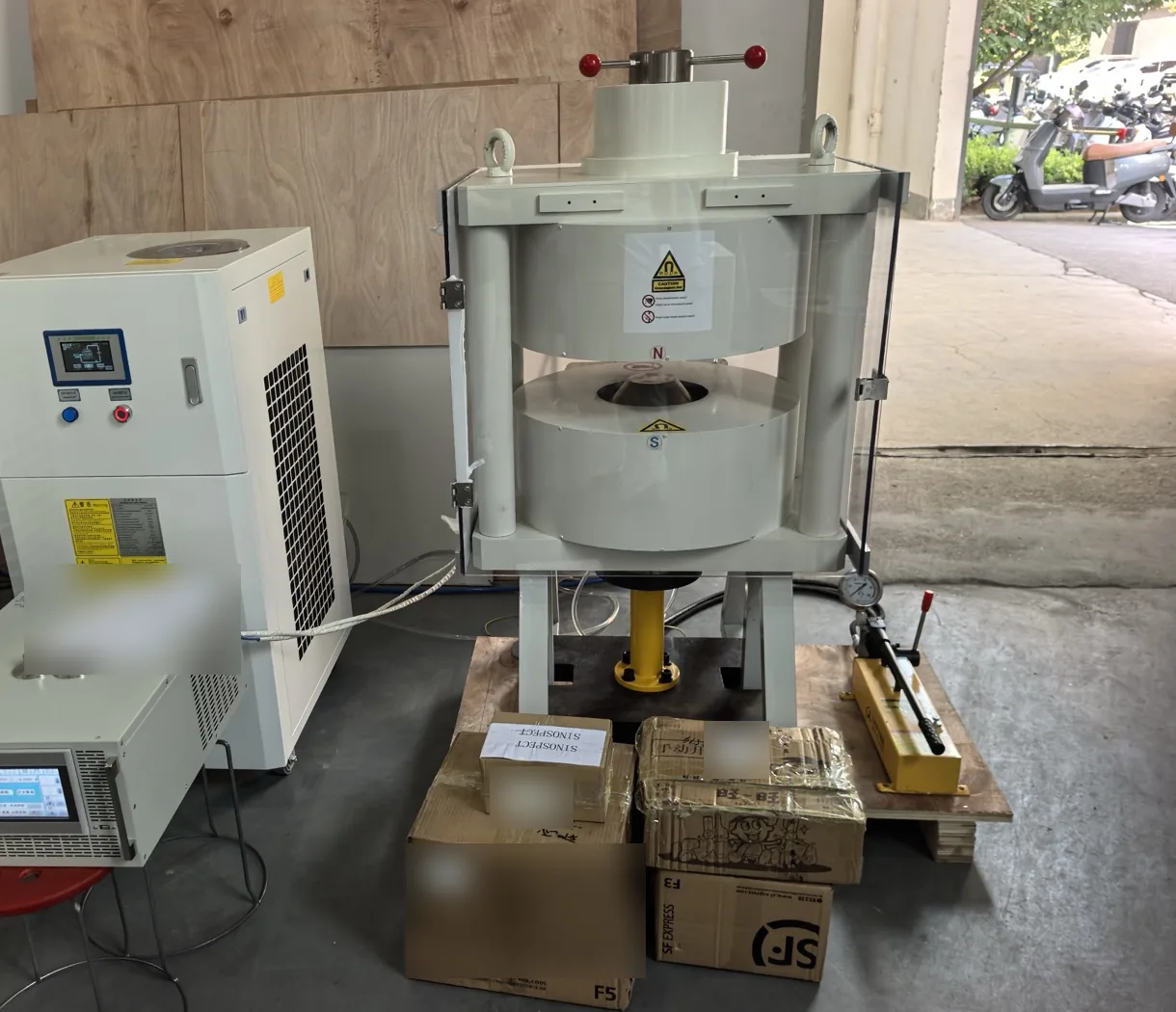
Sinospect’s role
The laboratory bought the press directly from the works and appointed Sinospect for the test. Sinospect reviewed the acceptance protocol with the buyer, supplied two field meters calibrated by an accredited laboratory with points at 2.0 T, arranged the test powder, which the buyer approved in writing, and sent our engineer to the works for two sessions, on 25 August and 1 September. The buyer followed the second session live on video for two hours.
What was supplied or controlled
A 5 t (50 kN) hydraulic press working under a vertical magnetic field, with a water-cooled electromagnet on Ø100 mm poles, a circulating-water chiller, a 0–200 V, 0–50 A DC power supply, a hand pump with pressure gauge, a die set with two pressure heads, a protective safety cover and the English operating manual: eleven deliverables, each checked against the protocol.
The recorded sequence
Agree the protocol
The buyer’s acceptance protocol reviewed point by point, two field meters calibrated with points at 2.0 T, and the test powder approved in writing.
First session, 25 August
Deliverables, identification, electrical safety, dimensions, hydraulics and the field profile at every gap.
Second session, 1 September
Field profiles at the binding currents measured with the buyer watching live; the failed pressing traced to the opened powder.
Close on written decisions
Five open items closed by the buyer on 7 September; Revision 2 recommends release for packing and shipment.
Factory acceptance checks
All eleven deliverables were present and identified. The coil insulation read 32.5 MΩ at 500 V DC, earth continuity was 0 Ω on all five exposed conductive parts, and the hydraulic circuit held 18 MPa for ten minutes with no pressure drop. The binding criterion was a field of at least 2.0 T across a 35 mm gap at the rated 40 A. Read at 37 A, the meter showed 2,004.7 and 2,006.7 mT, or 1,995.7 and 1,997.6 mT after the correction on its calibration certificate: 2.4 to 4.3 mT short of 2.0 T, at a current below rated. Across a 50 mm gap at 40 A the field read 1,651.9 mT against 1,765 mT on the works’ design curve, a value confirmed with the second meter (1,652.3 mT). The compacts from the first pressing trials crumbled. The cause was the test powder: its packaging had stayed open since the first session and its camphor binder had evaporated. Our engineer proposed a further trial with powder from the bottom of the carton, and in the works’ video of that trial the compacts held.
The evidence
The inspection report in two revisions, of 2 and 7 September 2026, with the record sheets signed at the works for both sessions, the calibration certificates of both meters, the works’ field data sheet, the powder datasheet, a photograph of every check, the session video and the buyer’s written decisions reproduced word for word.
Recorded result
Revision 1 left four items open, all needing the machine at rated current, together with the chiller flow reading. On 7 September the buyer closed them in writing. It accepted the 2.0 T criterion on the readings at 37 A and the works’ own readings of 2,028 mT at 38 A and 2,101 mT at 43 A, waived the thermal run and stray-field survey at rated current, and accepted three consecutive pressing cycles filmed by the works on 2 September. Revision 2 recorded every item as verified or closed by that decision, recommended release for packing and shipment, and listed the checks to make at site acceptance, among them a 40 A reading across 35 mm first, the thermal run and stray-field survey at rated current, the chiller flow rate, and a reverse-field step to demagnetise the compacts. The press shipped at the end of September. The laboratory rated the assignment 5 out of 5 and wrote: “They proposed solutions to unexpected issues and made the whole process for the FAT run smoothly.”
What this means for your order
For equipment built to a research specification, the acceptance protocol, the instruments and the test material decide what a factory test can prove. Agree the binding criterion and the current or load it is read at, bring calibrated instruments that cover it, and keep the test material sealed until the demonstration. Send your specification and draft protocol, and we will tell you what the test can verify and what should wait for site acceptance.