China industrial supply · Diesel generating sets & power equipment
Generating sets from China,specified for your site.
Sinospect supplies diesel generating sets, transfer switching and power equipment to EPC contractors, integrators and industrial buyers. Sets are specified against the site’s duty, load-bank tested in the factory against agreed acceptance criteria, and documented for the country they are going to.
Select an area to see what goes into the specification. A complete genset, an engine power pack and a site-ready installation are different scopes.
Conceptual supply-scope illustration. The proposal identifies the included equipment and site work.
Start with the operating duty.
Power requirement, operating hours, load behaviour and site conditions define the selection basis. Engine, alternator and controller references belong in the offer.
Prime or standby duty, voltage and frequency
Engine, alternator, cooling and controller
Load response and site conditions to be reviewed
The agreed outputEquipment schedule + named component list
ONE COORDINATED SUPPLY PACKAGE
The set. And the equipment around it.
Build the scope your installation needs. Each item is qualified for its duty, destination and interfaces.
01 / Prime or standby duty
Diesel generating sets
Prime and standby sets for construction power, plant commissioning, industrial backup and standalone installations — specified against the duty the site actually runs rather than a catalogue rating.
Engine, alternator and controller combination qualified against declared duty and site derating
Open-skid, canopied and containerised configurations, with sound attenuation set as a specification
Witnessed load-bank testing against the agreed acceptance and release criteria
02 / From source to outgoing circuits
LV distribution & transfer
Automatic transfer switches, changeover panels and low-voltage boards, reviewed for the interface with the set’s controller and with distribution equipment already on site.
ATS rating, transition type and control interface confirmed against the set
Board schedules and protection coordination reviewed before manufacture
Functional tests witnessed with the set rather than in isolation
03 / Supply matched to site conditions
Voltage stabilisation
Three-phase stabilisers and conditioning equipment for sites where the incoming supply, not the load, is the problem — common on grids with wide voltage excursions.
Correction range and response specified against measured site conditions
Compatibility with generating-set operation and transfer sequencing
Routine tests documented before shipment
04 / The connection to your network
Transformers & MV switchgear
Distribution transformers, MV switchgear and cable for interconnection and delivery points, qualified against applicable standards with documented factory tests.
Qualification against project specification and applicable standards
Documented routine and type tests, witnessed in the factory when needed
Coordination with local engineering on interfaces and dimensions
05 / Equipment for your hybrid system
Solar, inverters & storage
Photovoltaic modules, string and central inverters and LFP storage for hybrid and self-consumption projects, where a generating set is one half of the installation.
Manufacturer qualification against specification and applicable certifications
Grid compatibility, safety documents and operating limits reviewed
Factory inspection and pre-shipment test coordination
Design and connection decisions remain with your engineering team. The offer defines included tests, documents and site services.
A genset is bought on the datasheet and judged on the site
Generating sets for project sites worldwide are routinely sourced from qualified Chinese manufacturers. The attraction is a mix of manufacturing depth, rating availability and delivery capacity. The risk is that a set is ordered against a catalogue rating and arrives against a real duty, on a site with an ambient temperature, altitude, fuel quality or noise limit the order never mentioned.
The failures that follow are rarely mechanical. They are a missed commissioning date, an enclosure that breaches a site limit, a document pack that will not clear customs, or a warranty nobody can execute across a border. Sinospect controls that work: specification and duty review, manufacturer screening, witnessed load-bank testing, document coordination and shipment follow-up.
Between the load schedule and factory-side execution
01Input
Load schedule or specification
Load profile, prime or standby duty, site conditions and derating, single-line diagram and destination standards become the controlled buying basis.
02Award gate
Supplier qualified
Factories are screened against the required engine, alternator, controller and integration capability; offers and exclusions are compared in writing.
03Factory gate
FAT and load test
Load-bank and functional acceptance are witnessed against the agreed duty, with deviations corrected or carried as explicit release conditions.
04File gate
Documents closed
Test records, compliance evidence, marking, manuals and customs documents are checked before the set is packed and dispatched.
05Delivery gate
Delivery controlled
Packing and shipment are followed through to the agreed point, with commissioning interfaces, spares and warranty responsibilities already in writing.
Sinospect does not replace the EPC, owner’s engineer or local design office. The role is to control the manufacturer-side work that creates delay, technical drift and documentation gaps.
Compare the complete offer
Duty, components and delivery terms
A useful comparison puts the duty, equipment and commercial terms on the same basis before the price is judged.
Swipe across to see the points to resolve
Fictional comparison · method example
Comparison basis
Offer A
Offer B
What needs resolving
Power basis
500 kVA · prime
500 kVA · standby
Different duties. Confirm the required rating before comparing prices.
Component scope
Engine + alternator + controller identified
Engine identified; other models unspecified
Establish the exact build and proposed deviations.
Fuel data
At 75% of stated prime rating
At 50% of stated standby rating
Request consumption on a common load and duty basis.
Delivery basis
12 weeks after drawing approval · FOB
8 weeks after deposit · EXW
Align the trigger date, transport scope and delivery point.
Site support
Commissioning assistance separately priced
Not stated
Agree attendance, local responsibilities and warranty route.
Your decision fileComparable scope. Visible differences. A documented choice.
Fictional comparison
Specify the components that matter.
Already working to a named make? Include the exact reference and acceptable alternatives in the equipment schedule.
Manufacturer documentation for specification reference. Your offer identifies the proposed make, model and supply source.
Included with your Sinospect engagement
A shared view of the supply package.
Workbench supports agreed documents, inspection records and progress reporting. These example handover stages show the information to agree for your engagement—not a live project screen.
SINOSPECTFor review
WORKBENCH / POWER
One agreed technical basis
Equipment schedule · Rev B
01Duty, destination and operating conditions
02Component references and scope boundaries
03Open technical questions and drawing revisions
Example information structure · synthetic content
Workbench is included with your Sinospect engagement.
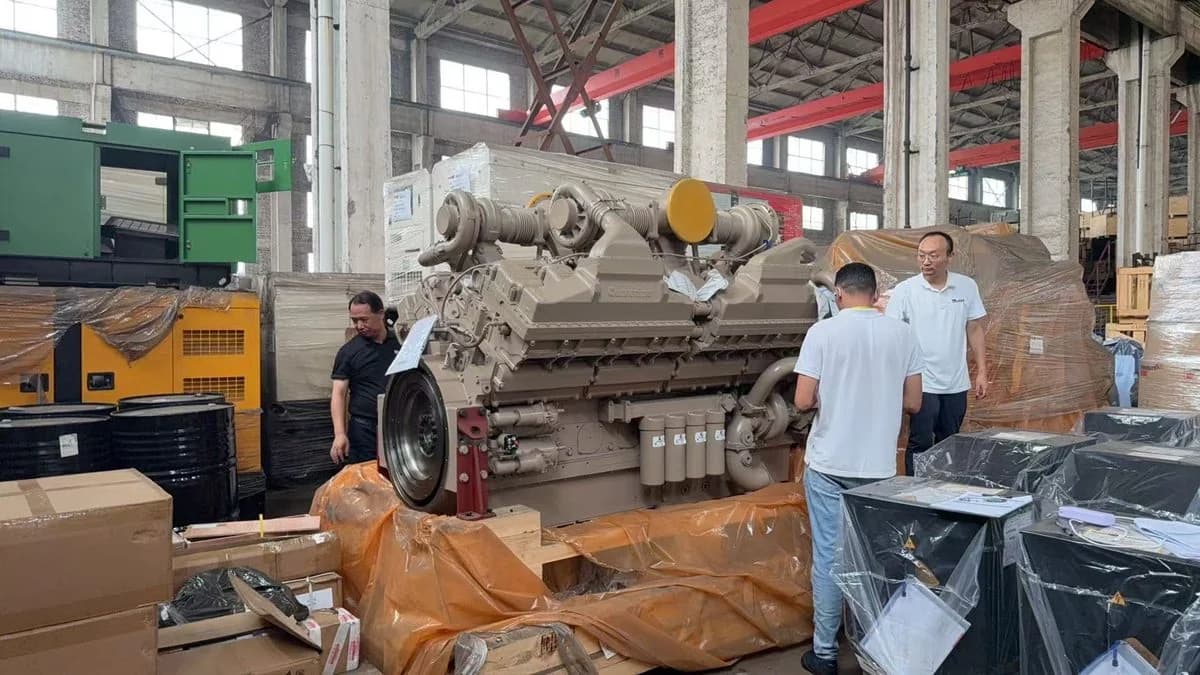
Published Sinospect field photography · engine power-pack test
From the specification to the factory floor
Check the build. Witness the agreed tests.
Sinospect coordinates the defined factory checks against the approved specification: component identification, agreed performance tests, findings and closure before release.
The test plan and applicable destination requirements are agreed per package. Any mandatory accredited or statutory assessment remains with the appropriately authorised party.
Document pack
Documents that clear customs and satisfy the owner
A set that is built, tested and shipped can still stop at a border. The document pack is assembled against the destination’s import requirements before manufacturing, not compiled from whatever the factory happens to issue at dispatch.
01
Technical file and test records
Datasheets, load-bank and routine test reports and witnessed acceptance records, checked against the specification the order was placed on.
02
Compliance and marking evidence
Applicable certificates, declarations and marking evidence assembled against the destination market’s requirements, not a factory’s default export set.
03
Customs and shipping pack
Invoice, packing list, origin and transport documents prepared so the consignment clears rather than sits.
Warranty terms, spare-parts conditions and after-sales responsibilities are settled separately and in writing, because they govern what happens on site months after the document pack has been accepted.
Buyer profiles
Who buys power equipment this way
Contractors, integrators and industrial buyers who need manufacturer-side control in China rather than a catalogue and a shipping date.
EPC and industrial contractors
Contractors needing temporary site power, commissioning power or plant backup on international projects, where a slipped delivery stalls a milestone rather than an invoice.
Integrators and resellers
Electrical equipment distributors and panel builders who integrate sets into their own scope and need a consistent supply basis, technical documentation and terms they can quote against.
Direct buyers and manufacturers
Industrial operators buying for their own installations, and equipment manufacturers integrating sets into distribution equipment they supply onward.
Start with the requirement
What needs powering?
A load schedule, specification or equipment list is enough to open the discussion. If the sizing is not settled, say so; the review scope is agreed before work starts.
01
Power & duty
kW / kVA if known; prime or standby use
02
Site & destination
Country, operating conditions and installation context
03
Timing & quantities
Units required and target delivery date
04
Existing documents
Load schedule, single-line diagram, specification or quotation
Your first written response
An initial assessment of the supply scope, missing inputs and the proposed next step. No call required to start.
Acknowledgement within one business day. Initial written assessment, or a request for missing information, within two business days.
Describe the requirement first. Agree a secure transfer before sending confidential files.
In the standard supply model, your contract and invoice are with Sinospect. The proposal defines the goods, price basis, delivery point and warranty responsibilities. Installation and commissioning are included only when expressly agreed.
Before you enquire
What if the commissioning date is already fixed?
Send the required-on-site date with the load schedule. The offer sets out production, tests, shipping assumptions and the delivery point; progress is then followed against the agreed programme.
Can you supply open, canopied or containerised sets?
Yes. State the sound limit, ambient conditions, footprint and access constraints. Enclosure, cooling, exhaust and transfer interfaces are confirmed for the offered configuration.
How are destination requirements handled?
Applicable standards, marking, import documents and required approvals are identified for the destination and equipment. The proposal assigns each responsibility; statutory approvals remain with the appropriately authorised parties.
What documentation clears customs?
Certificates, test reports, marking evidence and customs paperwork are compiled as part of the order and checked against the destination’s import requirements before the container leaves.
Who covers warranty and spare parts once it is on site?
When Sinospect supplies the set, the buyer brings warranty issues to Sinospect: we investigate against the agreed specification and acceptance evidence, manage the manufacturer behind the scenes and coordinate the contractually agreed remedy. Warranty holder, term, exclusions, spare-parts route and response path are settled in the order documents before the deposit; on a cross-border project they are named rather than assumed from a factory’s standard terms.
Can the documentation be provided in French?
French or bilingual documentation can be defined in the scope. The quotation identifies the manuals, schedules and reports concerned, alongside any destination-specific requirements.
Can you supply an engine power pack rather than a complete generator?
Yes, the two scopes are distinguished in the proposal. An engine power pack does not automatically include a main alternator, genset controller, fuel tank or canopy. The exact components, interfaces and documents are agreed before award.
Do you select and size the whole electrical installation?
Sinospect reviews the supply requirement and coordinates the agreed technical work. System design, load validation and final equipment acceptance remain with the buyer and its appointed engineer. Any additional engineering is separately defined before commitment.
What happens after shipment?
The proposal establishes the delivery point, warranty route, spare-parts scope and any commissioning assistance. Local attendance and response arrangements are confirmed for the destination; they are not assumed to be available worldwide.