

Service · Factory execution
Factory acceptance test China: FAT witness
- What you get:
- A factory acceptance test (FAT) witness in China records measured results and deviations for the buyer’s release decision.
- Turnaround:
- Test dates follow the agreed protocol; the report follows the witnessed tests.
- Price:
- USD 625 to 1,800 per engineer-day on site, including the report.
- Sample report:
- View sample (PDF)·Scope and fee example (PDF)
Send the equipment specification, factory location and proposed test protocol to arrange FAT witnessing in China. Sinospect defines the witness role, checks and evidence with the buyer, attends the agreed factory tests and reports measured results, open findings and a release, hold or retest recommendation.
- Buyer-side control point
- FAT hold point before equipment release
- Also called
- Factory witness test · witnessed factory test · FAT witnessing
- Engagement role
- Buyer-direct witness, or Sinospect factory QC on a Sinospect-supplied order
Send the file before the supplier fixes the test date.
We will confirm whether FAT is the right gate, what should be witnessed, and whether the assignment needs an inspector, engineer or discipline specialist. If the protocol or acceptance criteria are incomplete, the gaps are identified before anyone travels.
- What to send
- Specification, ITP or FAT protocol, equipment scope and supplier readiness
- Written response
- Right inspection tier, witness scope, missing inputs and earliest feasible date
- Assigned profile
- Inspector, engineer or discipline specialist matched to the equipment and test method
Quick answers
How do I arrange a FAT witness in China?
A factory acceptance test (FAT) witness in China attends the agreed equipment tests and records results, deviations and retest evidence for the buyer’s acceptance decision. Sinospect scopes attendance against the test protocol. On a buyer-direct inspection assignment Sinospect works for the buyer and is paid by the buyer only.
| What buyers ask for | What the contract or the supplier calls it | What actually happens |
|---|---|---|
| Someone to watch the machine being tested before it ships | Factory acceptance test (FAT) witnessing · factory witness test | The assigned inspector, engineer or discipline specialist attends the test at the factory and records measured results against your specification |
| Proof it really works, not photos and a video clip | Witnessed functional and performance testing | The tests are run in front of the witness, with values, duration, load and test conditions written down |
| A check that the right things are in the crate before it leaves | Pre-shipment inspection (PSI) | Quantity, packing, marking and visible condition after packing — shipment readiness, not performance |
| The paperwork the bank or the end client asked for | Signed FAT report and non-conformity log | A dated record of what was tested, what passed, what failed and what is still open |
| Someone to tell us whether it is safe to release the balance | Release recommendation | Release, release with comments, hold, rework or retest — the decision itself stays with you |
Can one FAT campaign cover several factories or repeated call-offs?
Yes, provided it is governed as one campaign rather than copied ad hoc from visit to visit. A master protocol, acceptance vocabulary, evidence standard and report format remain consistent; each factory or call-off then records its own scope, date, assigned personnel, instruments, findings, open items and disposition. The common format makes the site-specific results comparable.
| Operating shape | How it is controlled |
|---|---|
| Single FAT event | One defined unit, factory, protocol, witness scope and report |
| Multi-factory campaign | One master method with a separate call-off record, personnel assignment and finding set for each factory |
| Repeated surveillance programme | Planned and actual visits tracked under one reporting method, with site-specific hold points and open items |
How does a factory acceptance test (FAT) differ from a pre-shipment inspection (PSI) when sourcing equipment from China?
A FAT verifies whether equipment meets agreed technical, functional and documentation requirements before release, usually before final packing. A PSI instead confirms shipment readiness after packing: quantity, packing, marking, serial numbers and document pack. For complex equipment, buyers often run a FAT first, then a PSI before dispatch.
| Comparison point | Factory acceptance test (FAT) | Pre-shipment inspection (PSI) |
|---|---|---|
| Main purpose | Verify technical, functional and documentation requirements | Verify final shipment readiness |
| Typical timing | Before release, usually before final packing | After packing, before dispatch |
| Typical checks | Performance, configuration, safety, records, NCR disposition | Quantity, packing, marking, serial numbers, document pack |
| Best suited to | Industrial equipment, molds, machines, processing lines, engineered systems | Finished goods, packaging, accessories, simple spare parts |
What is FAT witnessing, and who decides whether to release the equipment afterward?
FAT witnessing means the agreed factory tests are observed, measured and recorded against the FAT procedure, with pass/fail captured via photo and video evidence. Sinospect supplies the witnessed evidence and a recommendation: release, release with comments, hold, rework or retest. On a buyer-direct order the buyer keeps the final release decision; on an order Sinospect supplies, Sinospect decides its own factory release.
| FAT deliverable | Purpose for the buyer |
|---|---|
| FAT witness plan and readiness note | Confirms planned scope, supplier readiness and required witnesses |
| Signed FAT report / test disposition | Records measured results and pass/fail status |
| Photo, video and measurement evidence | Supports the witnessed findings with traceable proof |
| Non-conformity and corrective-action log | Tracks NCRs, correction status and carry-forward points |
| Release / hold / rework / retest recommendation | Supports the buyer's final release decision |
What FAT scope should be witnessed before equipment release in China?
A buyer's FAT scope follows the agreed inspection-and-test plan, FAT procedure and acceptance criteria across five control points: ITP and readiness, equipment identity and conformity, functional and performance test witnessing, safety and protection checks, and documentation review with non-conformity disposition. Each is measured and recorded against agreed criteria.
| FAT control point | What is checked | Output |
|---|---|---|
| ITP, procedure and readiness | Acceptance criteria, supplier readiness, test bench, required witnesses | Readiness note and witness plan |
| Equipment identity and conformity | PO match, nameplate, model, serial number, drawings, configuration, finish | Identity and conformity record |
| Functional and performance tests | Measured values, duration, loading, output, control response, alarms, sequence | Pass/fail results with photo or video evidence |
| Safety, isolation and protection | Insulation, grounding, pressure/leak, emergency stops, guards, interlocks, calibration references | Safety and protection check record |
| Documentation and non-conformity | Certificates, calibration references, manuals, spare-parts lists, as-built changes | NCR disposition and corrective-action log |
What is a factory acceptance test in China, and when is it the right control?
A factory acceptance test in China is witnessed performance verification against the agreed ITP, producing measured results and a signed record before release. It is justified for industrial equipment, molds, machines, processing lines and engineered systems, where a post-shipment defect is expensive or slow to correct. Simpler items usually fit PSI or spot checks.
| Item type | Control tier | Why this tier |
|---|---|---|
| Industrial equipment, molds, machines, processing lines, engineered systems | FAT | A post-shipment defect is expensive or slow to correct |
| Finished goods and packaging | Spot check or PSI | Usually not the right tier for a FAT |
| Basic accessories, simple spare parts | Spot check or PSI | Usually not the right tier for a FAT |
01 · Scope
When a factory acceptance test is the right tier
Supplier quotations and buyer correspondence may refer to a factory witness test, source inspection or vendor inspection, but those labels are not automatically interchangeable with FAT. FAT is a defined factory hold point: the protocol, acceptance criteria, witness role, evidence, authority and release decision are agreed in writing; tests are then witnessed, measured results recorded, non-conformities dispositioned, and the buyer receives a written basis for release, hold, rework or retest. FAT is usually justified for industrial equipment, molds, machines, production lines and engineered systems where a defect discovered after shipment would be expensive, slow or operationally disruptive to correct. It is usually not the right tier for a container of finished goods, a packaging order, a basic accessories run or a simple spare-parts shipment; those usually belong in spot check or pre-shipment inspection in China unless there is a specific technical acceptance requirement.
It becomes useful when
- Industrial equipment has performance characteristics that must be witnessed before dispatch, not merely photographed or checked after packing.
- A transformer, generator, motor, pump, compressor, processing line or other technical machine must be tested against an agreed ITP or FAT procedure.
- A mold, tooling package or production fixture must be validated for fit, function, cycle expectations, surface finish, inserts, cooling or repeatability before release.
- Safety, isolation, protection, control logic, alarms or interlocks must be verified before the equipment leaves the supplier.
- A failed test, wrong configuration or missing accessory would be difficult to correct once the goods arrive at the destination site.
- A bank, partner, downstream customer or regulator needs a traceable factory-side record showing what was tested, what passed, what failed and what remains open.
- The FAT depends on a discipline specialist, project-specific competence evidence, or a calibrated instrument that must be confirmed before the test date.
- Several factories, equipment packages or repeat call-offs must be run under one protocol and reporting method without losing site-specific findings.
02 · Controls and evidence
FAT-specific control points inside the QA layer
Control point
ITP, FAT procedure and readiness
Sinospect confirms the inspection-and-test plan, FAT procedure, acceptance criteria, supplier readiness, test bench availability, required witnesses, the assignment profile and competence evidence, site-access and language needs, required instruments and calibration, and the difference between routine tests, type-test references and any special tests required for this order.
Control point
Equipment identity, visual and dimensional conformity
The inspected unit is tied to the purchase order, nameplate, model, serial number, drawings and agreed configuration. Visual condition, key dimensions, finish, assembly status, major components and accessories are checked before the functional test narrative begins.
Control point
Functional and performance test witnessing
Agreed tests are witnessed against the FAT procedure. Measured values, test duration, loading conditions, output, control response, alarms, operating sequence and pass/fail criteria are recorded with supporting photo or video evidence where useful.
Control point
Safety, isolation and protection checks
FAT-specific safety and protection points are verified where applicable: insulation, grounding, pressure or leak checks, emergency stops, guards, interlocks, protection devices, control cabinets, warning labels and isolation points. Calibration references and test instruments are checked when measurement evidence depends on them.
Control point
Documentation review and non-conformity disposition
Test records, certificates, calibration references, as-built changes, manuals, spare-parts lists and packing-readiness documents are reviewed while the equipment is still accessible. Non-conformities are classified, assigned to correction, accepted with conditions, carried forward, or used to support a hold or retest recommendation.
Evidence reviewed
Evidence captured during the FAT tier
- FAT basis and readiness record
- Purchase order, technical specification, approved drawings, approved component list, ITP, FAT procedure and acceptance criteria checked before the witness event.
- Supplier readiness confirmed: equipment complete, test bench available, test instruments identified, relevant documents prepared, and responsible supplier personnel present.
- Routine-test scope, type-test references, special test requirements and exclusions documented against the order.
- Witnessed test and measurement record
- Equipment identity, nameplate, model, serial number, major components and configuration photographed and tied to the test record.
- Functional, performance, safety, isolation or control tests witnessed against agreed criteria, with measured results and pass/fail status recorded.
- Test instruments, calibration references, test conditions and supplier explanations captured where they affect the reliability of the evidence.
- Assignment and campaign record
- Assigned role, discipline and experience basis documented against the equipment, protocol and test method before booking.
- Required instruments, ownership or supply responsibility, calibration reference and validity date identified before the witness event.
- For multi-factory or repeat-call-off work, the master protocol and report method remain controlled while each factory or visit keeps its own scope, date, personnel, evidence and finding record.
- Disposition and release record
- Non-conformities logged with severity, requirement reference, supplier response, corrective-action owner and target closure date.
- Corrective-action evidence, retest results, updated documents or as-built records captured where issues are corrected before release.
- Release, conditional release, hold, rework, retest or dispatch carry-forward recommendation prepared for the buyer's decision.
03 · Deliverables
Deliverables issued
Deliverable
For · Procurement, engineering and QAFAT witness plan and readiness note
A short record of the test and assignment basis: ITP, FAT procedure, acceptance criteria, equipment and factory readiness, assigned role or discipline, required instruments, covered factories or call-offs, witness scope and authority boundary before the FAT is run.
Deliverable
For · Engineering, operations and external reviewersSigned FAT report or test disposition
A structured record of what was witnessed, which results were measured, which criteria were applied, and whether each test passed, failed or remains open.
Deliverable
For · Engineering and operationsPhoto, video and measurement evidence
Traceable visual and measurement evidence tied to serial numbers, test steps, control points, NCRs and corrective actions.
Deliverable
For · Procurement and supplier teamNon-conformity and corrective-action log
Each issue classified, linked to a requirement, assigned to correction or retest, and tracked through closure or carry-forward.
Deliverable
For · Procurement and financeRelease, hold or carry-forward recommendation
A practical disposition supporting the buyer's decision: release, release with comments, hold, rework, retest, or dispatch with clearly identified open items.
04 · Risks controlled
Risks controlled
Risk
A PSI is used where FAT is required, so performance defects are only discovered after shipment.
Control response
Sinospect separates the QA tier decision first: PSI checks shipment readiness; FAT witnesses technical and functional acceptance before the equipment is packed or released.
Risk
The supplier controls the test narrative with photos, videos or internal records that do not prove the exact unit or test condition.
Control response
Sinospect witnesses the agreed tests at the supplier side, ties the evidence to the unit identity and records test conditions, measured values and acceptance criteria.
Risk
The equipment looks correct visually but does not match the required configuration, component list or operating sequence.
Control response
Nameplate, serial number, drawings, component list, major accessories, control logic and configuration are checked before and during the FAT.
Risk
Safety, isolation, protection or control issues are discovered only during installation or commissioning.
Control response
FAT-specific safety, isolation, alarm, interlock and protection checks are witnessed where applicable, with failed points logged before release.
Risk
Non-conformities are discussed verbally and then disappear from the record.
Control response
Each finding is written into the NCR or open-item log with severity, corrective action, evidence requirement and release implication.
Risk
The buyer receives a weak "passed FAT" statement that cannot support review by a bank, partner, downstream customer or regulator.
Control response
The FAT report shows what was tested, which criteria applied, what evidence was reviewed, which items remain open and what release recommendation follows.
Risk
A generic inspector is assigned without matching the equipment, test method, required discipline or instruments.
Control response
Sinospect defines the assignment basis before booking and records the role, competence evidence, site constraints and instrument requirements that make the person fit for the stated scope.
Risk
A multi-factory or repeat-call-off campaign drifts into different protocols, evidence standards and report language at each site.
Control response
A master protocol, acceptance vocabulary and reporting method remain controlled, while each factory or call-off retains its own personnel, evidence, findings and disposition record.
Risk
The quotation is not comparable because travel, overtime, cancellation, retest, reporting, specialist inputs or authority are left implicit.
Control response
The proposal states the commercial basis, included factories or call-offs, variation triggers, exclusions and authority boundary before work starts; no public rate card substitutes for a defined scope.
05 · Questions
Frequently asked questions
How do I appoint a FAT witness in China?
Send the specification, factory location and proposed test protocol. Sinospect defines the witness role and evidence, attends the agreed tests and reports results for the buyer’s decision. Sinospect assigns the inspector, engineer or discipline specialist the scope requires. The assignment is matched to the equipment and test; for a live scope, Sinospect can share the proposed role profile and relevant credentials.
What happens if equipment fails the factory acceptance test?
Sinospect records the non-conformity, the proposed correction and the agreed retest evidence. Open findings support a release, hold, rework or retest recommendation for the buyer.
How is FAT witnessing in China scoped and paid for?
On a buyer-direct inspection assignment Sinospect works for the buyer and is paid by the buyer only. The appointment defines the witness scope and deliverables. The quotation reflects the assignment and the evidence required. A defined one-off FAT may be quoted as a bounded fixed scope; recurring surveillance may use day or call-off terms; protocol-, specialist- or instrumentation-heavy work may be quoted as a fixed campaign covering the agreed outcome. The proposal states what is included and what would trigger a variation before work starts.
Who accepts the equipment after a FAT in China?
Authority is defined in writing for the assignment. Sinospect can observe and record the agreed tests, challenge evidence within scope, raise non-conformities, request clarification, witness corrective action or retest, and recommend release, hold, rework or retest. The buyer retains design authority, acceptance criteria, approval of concessions and variations, and the final release decision. On an order Sinospect supplies, Sinospect also decides its own factory release and final-balance payment under its contract with the manufacturer. Any specific delegation to Sinospect is recorded in writing. The witness signature records attendance and test results.
Who will attend my FAT in China, and how is that person selected?
The assignment is matched to the equipment and test. Sinospect reviews the equipment class, FAT protocol, applicable test method, acceptance criteria, required discipline, language and site-access needs, and any instrument or calibration requirements. The proposal states the role to be assigned and the evidence needed to confirm fit. During qualification, Sinospect can share the proposed role profile and relevant credentials when appropriate and authorised.
I am buying equipment from China for the first time. What do I actually get, and what do I have to do?
You send what you have: the purchase order, the specification or cahier des charges, and whatever the supplier is calling the test protocol. Sinospect tells you whether a full FAT is the right level for this order or whether a pre-shipment inspection would do the same job. If a FAT is right, Sinospect assigns the inspector, engineer or discipline specialist the scope requires to attend the test at the factory. You receive a signed record of what was tested and measured, a list of what failed or is still open, and a recommendation: release, release with comments, hold, rework or retest. On a buyer-direct order you keep the release decision; when Sinospect supplies the equipment, the same record supports Sinospect's own release decision. You stay at your desk, and the report is written for a reader who meets these standards occasionally.
The supplier keeps saying "witness test" and our contract says "FAT". Are those the same thing?
They overlap, and the contract decides. A FAT is the defined factory test event; a witness test describes how one or more agreed tests are observed. The written scope establishes who attends, which tests are covered, the acceptance criteria and who holds release authority. In a buyer-direct engagement, Sinospect's assigned witness is retained by the buyer and works independently of the supplier within the agreed scope. When Sinospect is the contracting supplier, the same activity is Sinospect's own factory-side QC, separate from independent third-party certification. The role, scope, criteria, evidence and authority are fixed in writing before the test date.
How do I know if FAT is the right tier for my order, or if a PSI would do?
That decision belongs in the Quality Assurance stage. Sinospect looks at value, technical complexity, whether performance must be witnessed, and how difficult correction would be after shipment. If the order is finished goods, packaging, accessories or a simple spare-parts run, a spot check or PSI is the usual tier, and a specific technical acceptance requirement moves it up. If the order is industrial equipment, tooling, a mold, a processing line or a machine with functional acceptance criteria, FAT is the usual tier.
Is a supplier video enough for FAT approval?
A video supports the record. Proof of the exact unit, the complete test conditions, the test duration, the measured values, the instrument references and the acceptance criteria comes from a witness on the bay. For high-value or technically complex equipment, on-site witnessing gives the stronger evidence and the clearer release basis.
FAT evidence method
Witnessed on the test floor. Recorded while correction was still possible.
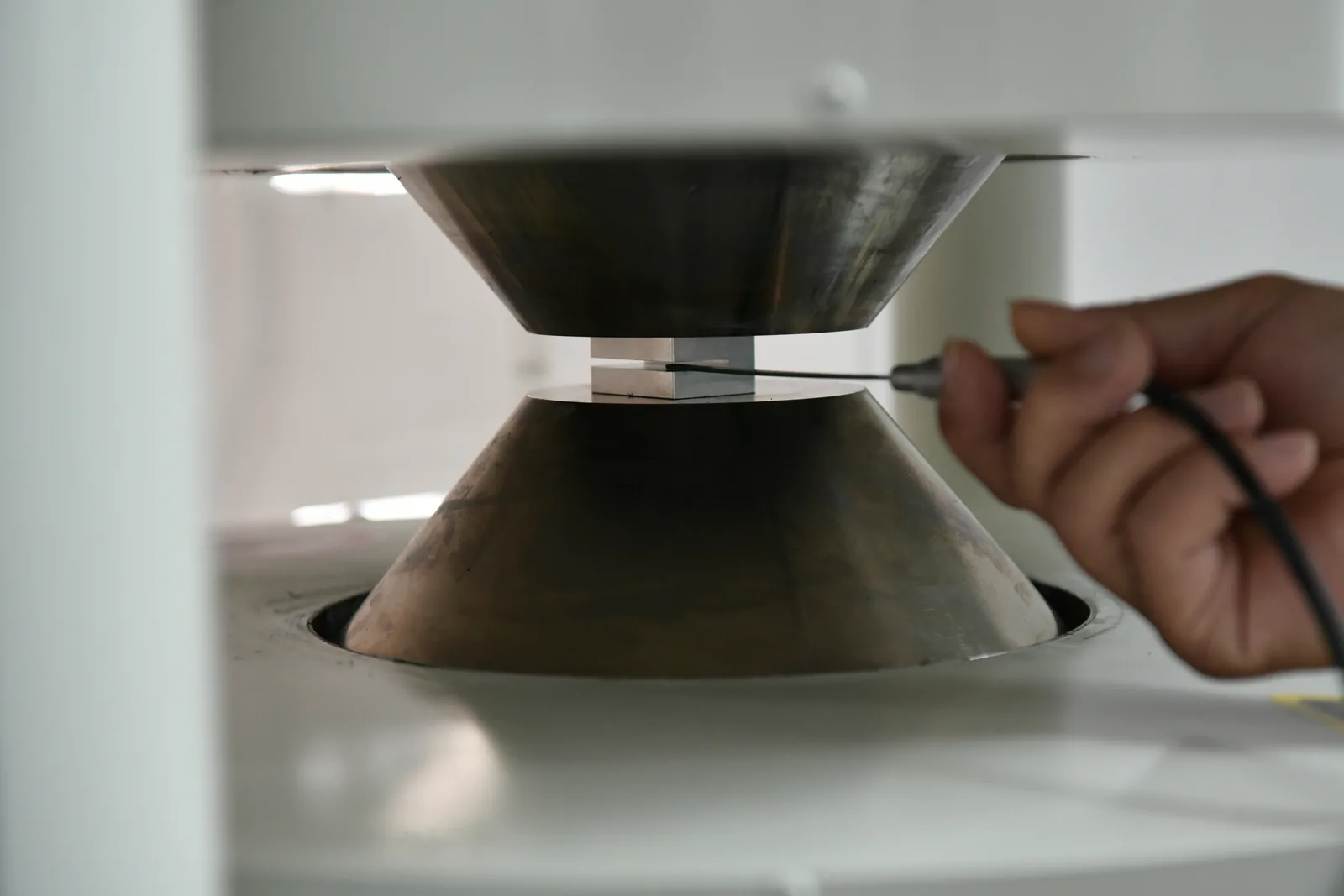
For a formal FAT assignment in China, the assigned quality engineer checks the agreed test point and records observations against the FAT procedure as the test is executed.
- Witness
- The defined test point was observed at the supplier facility.
- Record
- Observations were captured against the agreed procedure during execution.

An assigned quality engineer records observations against the agreed FAT procedure.
06 · Getting started
What to send — start with what you have
Send the specification and the FAT documents available. Sinospect uses them to propose the witness scope and identify the protocol details still needed.
FAT plan or test protocol
The procedure to witness, if one exists — otherwise the specification it should be built from.
Technical specification or cahier des charges
The performance the equipment must demonstrate, with the standards that apply.
Purchase order, factories and campaign shape
What was ordered, every factory or test location, and whether this is one FAT or a repeat campaign, so the call-offs can be planned correctly.
Acceptance criteria
Pass and hold thresholds, tolerances and the test conditions that decide release.
Expected readiness date
When the supplier expects the equipment ready to witness, so the FAT is timed before dispatch.
Required discipline, competence evidence or instruments
Any buyer, lender, end-client or site requirement that affects personnel selection, accepted evidence, experience, test equipment or calibration.
Send the documents available. Sinospect identifies the information needed to define the scope.
Schedule a witnessed FAT in China
Send the equipment scope, supplier details and whatever specification or FAT protocol you have. Sinospect acknowledges the request within one business day. When the file is sufficient, the written scope assessment follows within two business days, covering whether FAT is the right gate, the proposed assignment profile and campaign shape, what will be witnessed, the earliest feasible test date, and which commercial or authority assumptions need confirmation. Once booked, the assigned inspector, engineer or specialist attends the test and returns the signed FAT record for your release decision.