

Service · Factory execution · FAT
Switchgear & control panel FAT witnessing in China
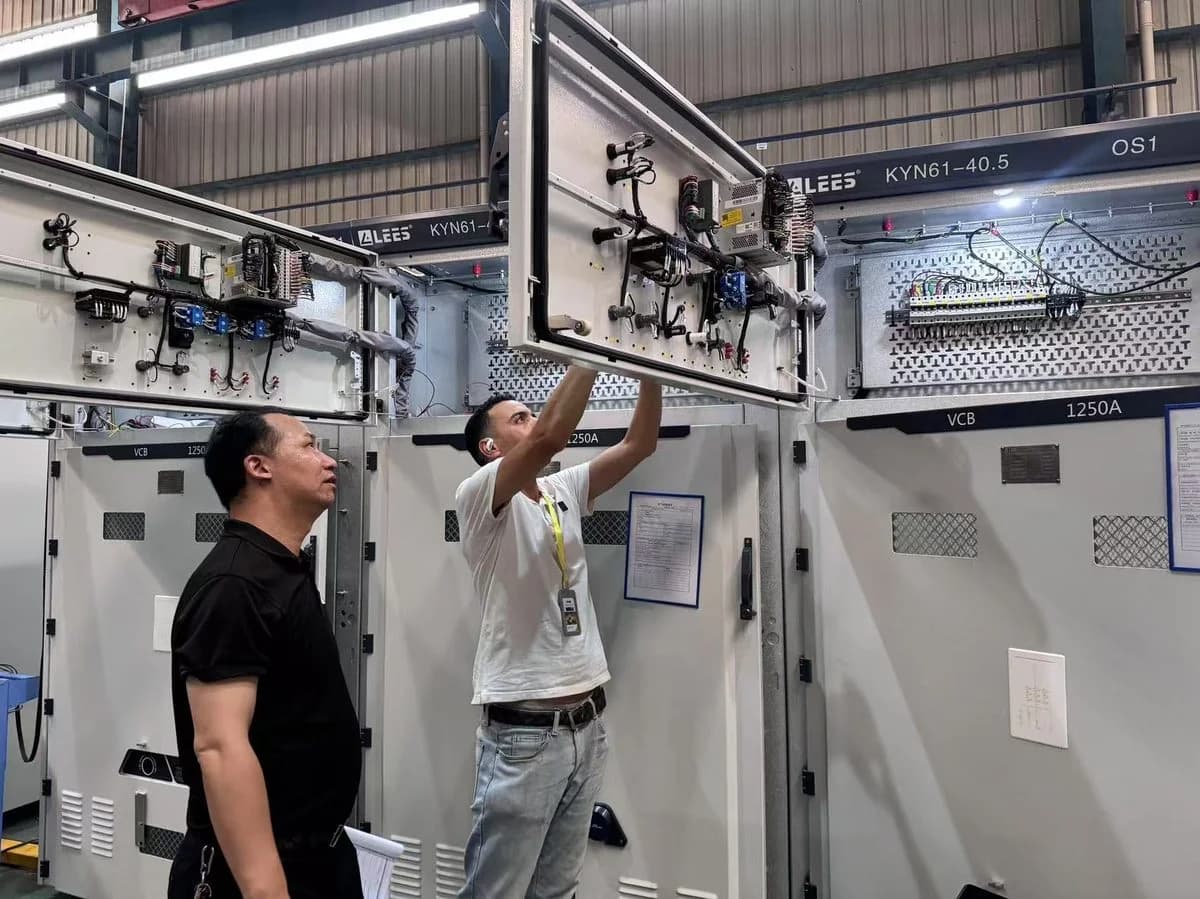
For 33, 36 and 40.5 kV switchgear, Sinospect proposes a named engineer and can submit the CV, scope and report format for buyer or consultant pre-approval. On a buyer-direct order, the engineer witnesses the FAT independently against the project-specified IEC 62271-1/-200 editions as applicable, approved drawings, settings and test schedule. On a Sinospect-supplied order, the same work is supplier-side quality control; any required independent or accredited witness remains separate. Each point is linked to the panel identity and calibration references; final acceptance follows the signed contract.
- Equipment class
- 33 / 36 / 40.5 kV MV switchgear, plus LV switchgear, MCCs and control panels where scoped
- Test basis
- Project-specified IEC 62271-1 and IEC 62271-200 editions as applicable, approved drawings, settings and the buyer's test schedule
- Review path
- Named engineer, CV and report format available for buyer or consultant pre-approval
- Engagement output
- Buyer-direct: independent witness record; supplied order: supplier-side QA/QC record. Both include a Pass / Fail / Not Witnessed matrix, identity-linked evidence and NCR/retest log
Quick answers
What your consultant receives
For a buyer-direct order, the independent engagement is structured so the consultant can review who attended, what was scheduled, which panel or shipping unit each result belongs to, what was actually witnessed and what remains open. When Sinospect supplies the equipment, the corresponding inspection is supplier-side quality control and any required independent or accredited witness remains separate. In both cases, approval authority stays as stated in the signed contract.
| Document | What it contains | Control convention |
|---|---|---|
| Named engineer and scope | Engineer identity, relevant experience summary, proposed witness scope and exclusions submitted before attendance | CV and scope available for buyer or consultant pre-approval |
| Approved test basis | ITP/FAT procedure, project-specified IEC 62271-1/-200 editions and parts applicable to the order, drawings, settings and acceptance criteria | Revision-controlled basis agreed before the witness event |
| Executed witness matrix | Every scheduled point, measured value, instrument reference and result | Pass / Fail / Not Witnessed, recorded for each scheduled point |
| Identity and calibration evidence | Nameplates, panel or shipping-unit references, test setups and calibration references | Each result linked to the equipment and instrument used |
| Non-conformity and retest record | Requirement reference, supplier response, correction and re-verification status | Open items remain visible until closed or accepted by the buyer |
| Signed witness report | Photo evidence, executed results, exclusions and release / hold / retest recommendation | Structured for consultant review; acceptance authority follows the signed contract |
What does switchgear FAT witnessing in China cover?
On a buyer-direct order, an independent engineer verifies the assembly against approved drawings, then witnesses the routine tests — protective-circuit continuity, insulation and dielectric withstand, mechanical operations, interlocks — and the functional checks of controls, metering and protection agreed in the test schedule. Results are recorded against acceptance criteria in a signed witness record; the buyer makes the release decision under its contract. When Sinospect supplies the equipment, this work forms part of Sinospect's supplier-side quality control, and any contractually required independent or accredited witness is appointed separately.
| Test group | What is witnessed | Acceptance basis |
|---|---|---|
| Construction and wiring | Assembly against approved drawings, point-to-point wiring, terminations, labelling, clearances and creepage | Approved schematics and IEC 61439 / IEC 62271 as applicable |
| Electrical routine tests | Protective-circuit continuity, insulation resistance, dielectric withstand | Product standard and purchase specification |
| Mechanical and interlocks | Operating cycles, racking, earthing switch, interlock logic, door and key interlocks | Test schedule and manufacturer procedure |
| Protection and control function | Secondary injection of relays, control logic, alarms, metering and indication by simulation | Settings file, logic diagrams and the agreed schedule of tests |
| Documentation | Routine-test certificates, settings records, as-built markups, manuals | Contract document list |
Why witness a panel FAT before shipment?
Because the same defect costs hours at the factory and days at site: a mis-wired CT circuit, a failed interlock or a wrong label is corrected on the shop floor before packing, but becomes an outage, a variation order or a safety event after installation. At a witnessed FAT the correction is still entirely the supplier's task, before packing.
| Defect found | At the witnessed FAT | At site |
|---|---|---|
| Wiring error in a protection circuit | Re-terminated and re-verified the same day | Fault-finding under schedule pressure, possible re-energization delay |
| Interlock fails its sequence | Adjusted and re-witnessed before packing | Safety observation, site rework, acceptance dispute |
| Missing settings or as-built records | Logged as an open item blocking release | Commissioning delay while documents are chased across time zones |
01 · Scope
When switchgear FAT witnessing is the right control
Panel-shop quality lives in the details a photograph cannot prove: torque on a busbar joint, the routing of a CT circuit, whether the interlock actually prevents the unsafe sequence or merely exists on the drawing. Errors found after installation require correction on site. Witnessing the factory acceptance test is justified whenever the assembly carries protection functions, the configuration is project-specific, or downstream rework would hit a schedule that cannot slip. For catalogue breakers or simple enclosures bought as commodities, a pre-shipment inspection is usually the right tier instead.
It becomes useful when
- 33, 36 or 40.5 kV assemblies carry protection, metering or control functions that must demonstrably work before dispatch.
- The panels are project-engineered — custom schematics, project settings, project labelling — rather than catalogue items.
- Interlocks, earthing switches or racking mechanisms guard safety sequences that a certificate alone cannot prove.
- Relay settings and secondary-injection results must be on record before site cabling begins.
- The installation schedule leaves room for commissioning only, or a different team from the one that specified the panels will install them.
- A lender, EPC, consultant or end client requires an independent factory-side record before release or milestone payment.
02 · Controls and evidence
What the witness controls in the panel shop
Control point
Engineer, report format and test basis agreed before attendance
The named engineer, CV, witness scope, report format, approved schematics, single-line diagram, settings file and test schedule are submitted for buyer or consultant review before the visit. Assembly readiness and instrument calibration references are checked before the test date.
Control point
Construction and wiring verification
Assembly checked against the approved drawings: component ratings and makes, busbar arrangement, clearances and creepage, point-to-point wiring on control and CT/VT circuits, terminations, ferruling and labelling.
Control point
Electrical routine tests witnessed
Protective-circuit continuity, insulation resistance and dielectric withstand witnessed with measured values recorded against the product standard and specification.
Control point
Mechanical operations and interlocks
Operating cycles, racking, earthing-switch operation and the interlock logic exercised through the defined sequences — including the sequences the interlocks must prevent.
Control point
Protection, control and documentation
Relay function proven by secondary injection where specified, control logic and alarms exercised by simulation, settings compared to the approved file; routine-test certificates, settings records and as-built markups reviewed before release.
Evidence reviewed
Evidence captured during the witnessed FAT
- Test basis and readiness record
- Named engineer, CV, witness scope and report format submitted before attendance.
- Approved drawings, settings file, ITP/FAT procedure, test schedule and acceptance criteria checked before the witness event.
- Assembly completeness, test instruments and calibration references, and responsible supplier personnel confirmed.
- Witness scope with exclusions documented — which functions are proven at FAT and which remain for site commissioning.
- Witnessed verification record
- Panel or shipping-unit identity photographed and tied to the record: nameplates, component makes and ratings, layout against drawings.
- Every scheduled point marked Pass, Fail or Not Witnessed, with measured values, instrument references and the applicable criterion.
- Wiring corrections, failed sequences and retests captured as they happen, with photo evidence where useful.
- Disposition and release record
- Non-conformities logged with severity, requirement reference, supplier response and re-verification status.
- Open items that do not block release carried forward explicitly with owners.
- Release, conditional release, hold or retest recommendation prepared for the buyer's decision and consultant review.
03 · Deliverables
Deliverables issued
Deliverable
For · Buyer, consultant, procurement and engineeringEngineer CV, witness plan and readiness note
The named engineer, relevant experience summary, agreed witness scope, report format, drawing/settings basis and readiness status before the visit.
Deliverable
For · Engineering, project and external reviewersSigned switchgear FAT witness report
Identity-linked construction verification and executed tests with measured values and Pass / Fail / Not Witnessed status, structured for consultant review.
Deliverable
For · Engineering and operationsPhoto evidence pack
Labelled visual evidence of panel identity, construction, wiring, test setups and corrected points, linked to the report.
Deliverable
For · Procurement and the supplierNon-conformity and re-verification log
Each wiring error, failed sequence or document gap classified, tracked through correction and re-verification.
Deliverable
For · Procurement and financeRelease recommendation
Release, release with comments, hold or retest — a written recommendation for the contract-defined packing and payment decision, which the contract's acceptance authority then takes.
04 · Risks controlled
Risks controlled
Risk
Wiring errors in control or CT/VT circuits ship inside a finished-looking cabinet and surface during commissioning.
Control response
Point-to-point verification against the approved schematics is witnessed and recorded before packing, with corrections re-verified on the spot.
Risk
Interlocks exist on the drawing but the built sequence does not actually prevent the unsafe operation.
Control response
Interlock logic is exercised through the defined sequences — including the prohibited ones — and the result is recorded.
Risk
Relays arrive with factory-default or wrong settings and the error is found at energization.
Control response
Settings are compared to the approved file and protection function is proven by witnessed secondary injection where specified.
Risk
Dielectric or continuity tests are reported as passed on unverified instruments or conditions.
Control response
Instrument references, calibration and test conditions are recorded with each measured value before it counts toward acceptance.
Risk
The FAT/SAT boundary blurs and a function slips between the two tests, assumed proven by each.
Control response
The witness report states explicitly which functions were proven at FAT by simulation and which remain for site commissioning.
Risk
A consultant receives a generic factory certificate detached from the ordered panels and the executed witness scope.
Control response
The report links panel identity, scheduled points, results, calibration references, exclusions and open items in one reviewable record.
05 · Background resources
Related
- Service · Factory acceptance test in ChinaFAT scope, control points and deliverables.
- Service · Transformer FAT witnessingThe sibling scope for power and distribution transformers on Chinese test bays.
- Service · Switchgear & GIS partial-discharge witnessingThe deeper scope when PD decides acceptance: test-object level, defect-pattern interpretation and retest after rework.
- Service · PD test witnessing at FATThe general PD witness scope across transformers, instrument transformers and HV cable systems.
- Tool · FAT checklist builderCompose a FAT checklist for LV/MV switchgear and control cabinets from the equipment preset.
- Resource · Factory acceptance test checklistThe twelve-section FAT checklist, downloadable as a printable PDF.
- Sector · EnergyHow Sinospect supports energy-sector buyers across supply, inspection and delivery.
06 · Questions
Frequently asked questions
Can Sinospect provide a third-party engineer in China for a 33 kV switchgear FAT under IEC 62271?
On a buyer-direct order, yes, subject to the factory location, test window and agreed scope. Sinospect proposes a named engineer and can submit the engineer CV, witness scope and report format for buyer or consultant pre-approval before attendance. The witness basis uses the IEC 62271-1 and IEC 62271-200 editions incorporated by the project as applicable to the ordered assembly, plus the approved drawings, settings and test schedule. Each scheduled point is recorded as Pass, Fail or Not Witnessed. Final acceptance follows the signed contract; Sinospect does not guarantee a third party's approval. On a Sinospect-supplied order, the corresponding inspection is supplier-side quality control and any required independent or accredited witness remains separate.
Which switchgear and panel tests are witnessed during a FAT in China?
The witnessed scope follows your specification, single-line diagram and the agreed test schedule. For LV assemblies this typically covers the routine verification of IEC 61439: construction and wiring inspection against the approved drawings, clearances and creepage, protective-circuit continuity, insulation resistance and dielectric withstand, and functional tests of controls, metering and indication. For 33, 36 and 40.5 kV MV switchgear, IEC 62271-1 and IEC 62271-200 apply as relevant to the ordered assembly, with mechanical operation, interlocks and voltage tests witnessed as specified. Protection relay checks by secondary injection are witnessed where your contract requires them.
Is a wiring check really worth an independent visit?
Wiring and configuration errors can emerge at site — after the panels are fixed to a wall, cabled and under schedule pressure. A witnessed point-to-point and functional check against the approved schematics converts "the drawings were followed" from an assumption into a record.
What happens if the assembly fails a witnessed test?
Each failure is recorded as a non-conformity with the requirement reference and the supplier's response, and the corrected point is re-verified before the record closes. Failures that touch safety — protective continuity, dielectric withstand, interlocks — normally support a hold recommendation until the retest passes. On a buyer-direct order, the buyer makes the release decision under its contract. On a Sinospect-supplied order, Sinospect records a supplier-side quality-control disposition; buyer acceptance and any payment or shipment consequence follow the signed contract.
Can functional tests be witnessed when the site systems are unavailable?
Yes — that is normal at FAT. Control and protection functions are exercised by simulation: secondary injection for relays, forced signals for I/O, test supplies for control circuits. The witness record states which functions were proven by simulation and which remain for site commissioning, so the boundary between FAT and SAT stays explicit.
Does this cover control cabinets and automation panels as well as switchgear?
Yes. The same witness structure applies to control cabinets, MCCs, automation and instrumentation panels: construction against drawings, wiring verification, insulation and continuity checks, then witnessed functional simulation of the control logic, alarms and interfaces defined in your specification.
07 · Getting started
What to send — start with what you have
Approved drawings are the ideal starting point, but a specification or even the supplier's quotation is enough for Sinospect to propose the witness scope and a named engineer.
Single-line diagram and schematics
The approved drawings the assembly must match — the basis of the construction and wiring verification.
Specification, ITP or schedule of tests
The applicable IEC 62271 parts, tests, witness points and acceptance criteria the contract requires, if already defined.
Consultant review requirements
Any required engineer-CV format, report template, witness-point coding or pre-approval process.
Settings file, where protection applies
Approved relay settings so witnessed secondary injection proves the right values.
Purchase order, panel list and builder details
What was ordered, the panel or shipping-unit identities, and where the shop is so attendance can be arranged.
Expected test-readiness window
When the builder expects the assembly complete, so witnessing lands before packing.
Send the documents available. Sinospect identifies the information needed to define the scope. The public FAT methodology shows how the evidence package is structured.
Arrange switchgear FAT witnessing
Send the voltage class, panel list, IEC basis, factory, test window and any consultant pre-approval requirements. On a buyer-direct order, Sinospect can propose an independent China-side witness; on a Sinospect-supplied order, the work is supplier-side quality control. Sinospect acknowledges the request within one business day. When the file is sufficient, the initial written assessment follows within two business days with the proposed engineer, witness scope and quotation; otherwise, Sinospect identifies the information still needed.