

Guide
Buying diesel generating sets from China: ratings, the offer, the factory test and shipping
Last updated
Sinospect supplies generating sets and engine power packs from China, load-tested at the plant, or witnesses the test of a set you buy directly. Send your generating-set requirement →
This guide covers diesel generating sets from about 20 kVA to a few megawatts, open-frame, canopied or containerised, bought from Chinese assemblers for construction sites, plants, hospitals, telecom sites and off-grid installations. It follows the order of a purchase: the rating, the offer, the checks before payment, the factory test and the shipment.
Start with the rating: prime or standby
ISO 8528-1 defines the ratings of a generating set; the four main ones are below. The same set carries different figures depending on how it will run, so two offers are only comparable when they quote the same rating.
| Rating | How the set runs | Typical use |
|---|---|---|
| Continuous power (COP) | Constant load, unlimited hours a year | Base-load plants, island grids |
| Prime power (PRP) | Variable load, unlimited hours; average over 24 h at most 70% of PRP | Main supply of a site without a grid, construction power |
| Limited-time running power (LTP) | Constant load, up to 500 hours a year | Planned peak shaving |
| Emergency standby power (ESP) | Variable load, only when the mains fails, up to 200 hours a year | Backup of a reliable grid: hospitals, buildings, data rooms |
Standby is the larger number on the datasheet, so it is the one some offers lead with. A set that will be the only supply of a site must be sized on prime power. Many engine makers allow 10% over prime power for one hour in twelve; a standby rating usually allows no overload.
The rating is given in kVA at a power factor of 0.8 lagging, so a 500 kVA set gives 400 kW. Motors, pumps and compressors draw reactive current and a high current when they start: the kVA rating, and the alternator behind it, decide whether the set can start your largest motor without the voltage collapsing.
Datasheet ratings hold at standard reference conditions, set by ISO 3046-1 at 25 °C, 100 kPa and 30% relative humidity. Above the altitude and temperature the engine maker states, the output must be derated. For a site at 40 °C or more, ask for the derated output at the site’s conditions and for the radiator’s design ambient temperature: the offer should state both.
Performance class: how well the set holds voltage and frequency
ISO 8528-5 sets four performance classes, G1 to G4, for how far voltage and frequency may move when load is added or removed, and how fast they must recover. G1 suits simple loads such as lighting and heating, G2 general loads with pumps and fans, G3 telecom and thyristor-controlled loads, and G4 the most sensitive loads, such as data processing. Name the class in the specification: it decides the governor, the voltage regulator and the size of the load steps the set must accept. Most turbocharged engines cannot take their full load in one step; ISO 8528-5 gives guide values and the engine maker states the steps the engine accepts.
What the offer must state
| Item | What the offer should state |
|---|---|
| Rating | kVA and kW at 0.8 power factor, prime or standby, voltage, frequency and phases |
| Engine | Make, model, production plant, cylinders and displacement, governing (mechanical or electronic), emission stage where the destination requires one |
| Alternator | Make, model, insulation class, voltage regulator, and the rating at the site's temperature |
| Controller | Make and model, functions included: auto start, mains failure, remote monitoring, synchronising |
| Build | Open frame, canopy or container; sound level and the distance it is measured at; base fuel tank and running hours on it; radiator design ambient |
| Scope | Transfer switch, synchronising panel, battery and charger, exhaust silencer, spare parts and tools |
| Test | Factory load test: steps, hold times, overload step, load bank type and power factor; whether a witness may attend |
| Commercial | Delivery term and port, packing, lead time, warranty in months or running hours and how a claim is handled |
When two offers differ only in price, check the engine and alternator first. A lower price often means a different engine series, a smaller alternator than the kVA rating needs, or a radiator rated for a cooler climate than the site.
Check the dataplates before you pay
Ask for photos of the engine, alternator and controller dataplates of the actual units on your order, not catalogue pictures. Each dataplate shows a model, a serial number, a rating and a date. The engine serial number can be checked with the engine maker’s service network, and the dates show whether a unit offered as new production has been in stock for years. A plant that cannot photograph the dataplates before the order may not have the units yet: ask for the production lead time in writing instead of a promise that the sets are in stock. The engine makers page shows who makes each engine family and what each maker lets you check.
The factory load test
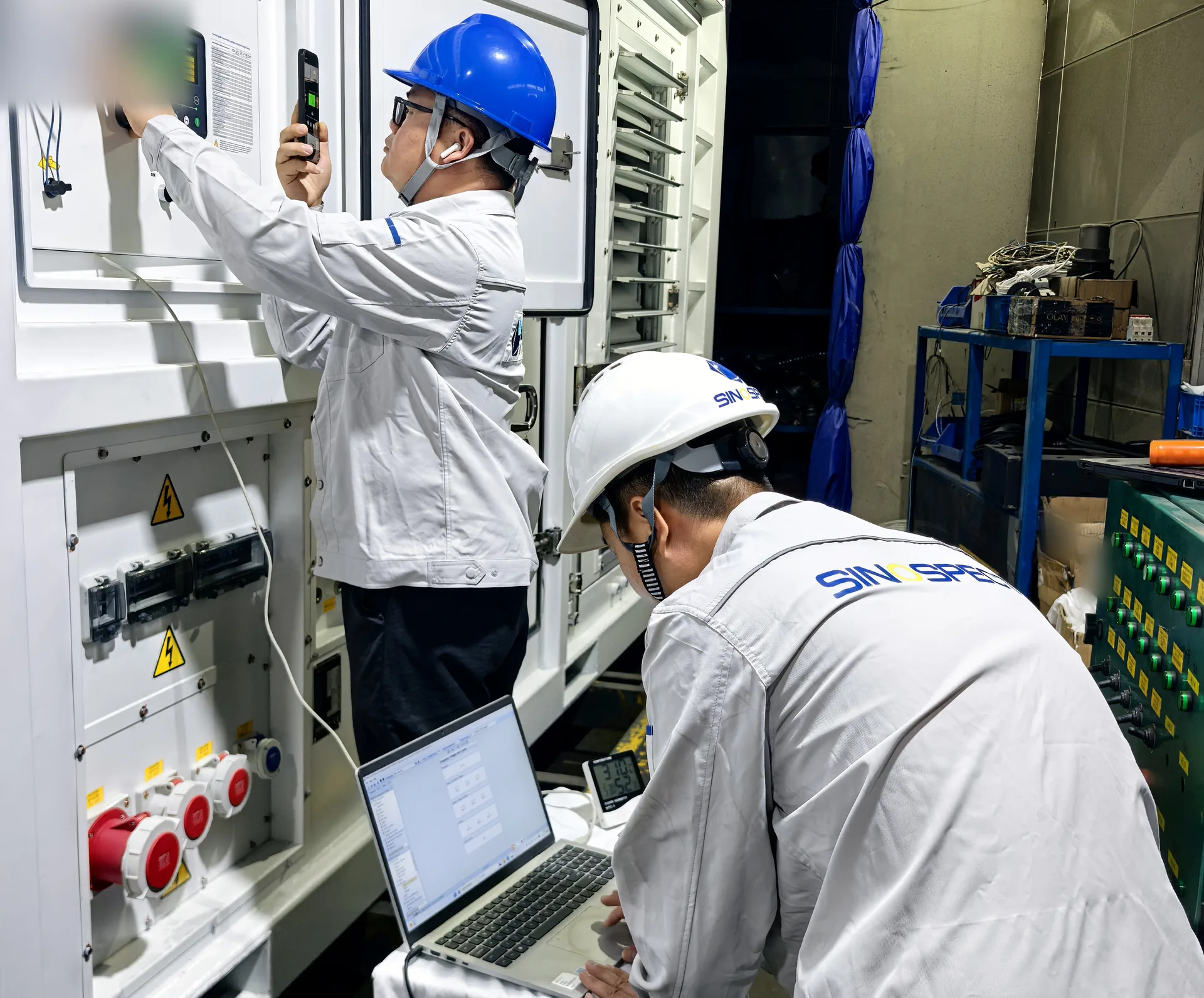
Every set should be run on a load bank at the plant before it ships. ISO 8528-6 describes the test methods; the programme the contract names sets the steps, the hold times and the overload. A typical programme looks like this:
- 25%Start, warm-up and first readings
- 50%Held until voltage, frequency and temperatures settle
- 75%Readings recorded, leaks and vibration checked
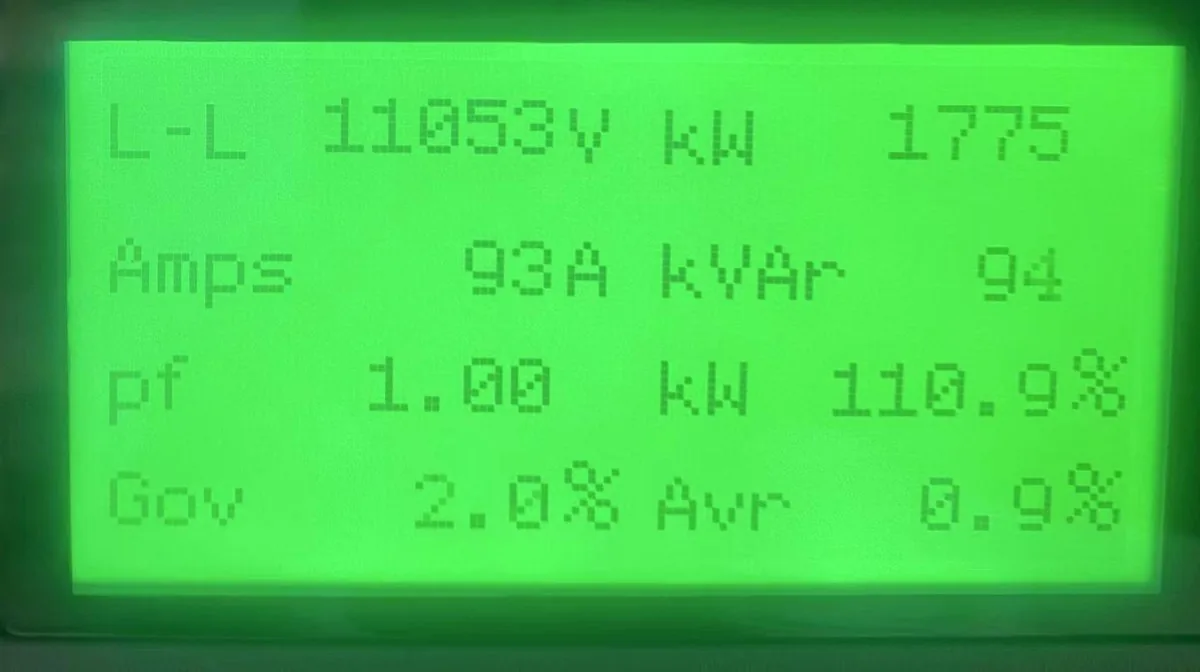
- 100%Full prime power, held for the agreed period
- 110%Overload step, for the time the contract names
The steps, hold times and overload come from the agreed FAT programme; the 110% step applies only when the engine's prime rating allows it.
At each step the readings are recorded: voltage, frequency, current, kW, kVA and power factor, coolant temperature and oil pressure. The protections are then triggered one by one (low oil pressure, high coolant temperature, overspeed, emergency stop) to show that the set shuts down as it should.
Ask which load bank the plant will use. A resistive load bank works at a power factor of 1.0: it loads the engine to its full kW, but the alternator then carries only about 80% of its rated current, and the alternator’s excitation is never pushed to the level a 0.8 power-factor site load demands. A resistive-reactive load bank at 0.8 power factor tests the set at its full kVA. Many plants have resistive load banks only. If yours does, agree in writing what the test proves and what is left for the site test. For a critical set, a witnessed generator FAT ties every reading to the serial numbers on your order.
Selling into the EU
A generating set placed on the EU market is machinery. A mobile or transportable set needs an engine with EU emissions type-approval under Regulation (EU) 2016/1628 (Stage V); a permanently installed set is outside that regulation, though national rules, or Directive (EU) 2015/2193 on medium combustion plants from 1 MW thermal input, may apply. Sets of less than 400 kW also fall under the outdoor noise Directive 2000/14/EC, with a guaranteed sound power level on the marking. The machinery rules change on 20 January 2027: see the guide to the EU Machinery Regulation 2023/1230. Outside the EU, check the destination’s own rules before ordering.
Shipping
Open-frame sets of a few hundred kVA usually travel in a 20 ft or 40 ft container; a containerised set can travel as its own container when it carries a valid CSC safety-approval plate, and otherwise goes on a flat rack or as breakbulk. Ask the forwarder how they will declare the set before booking. Many accept generating sets as general cargo only with the fuel tank drained and the battery removed or disconnected; a set shipped with fuel or a fitted battery can be declared as dangerous goods. The guide to shipping industrial equipment from China covers the delivery terms and the dangerous-goods screen.
What moves the price and the lead time
- the engine make and series, and the alternator behind it;
- prime or standby rating, and derating for the site’s heat and altitude;
- open frame, canopy or container, and the sound level required;
- the controller, and whether sets must synchronise;
- fuel tank size, transfer switch, spare parts and tools;
- the test programme: load steps, overload, power factor, witness;
- emissions and noise rules at the destination, packing and the delivery term.
Buyer checklist
Before award
- Rating in kVA and kW at 0.8 power factor, prime or standby, at the site’s temperature and altitude.
- Engine, alternator and controller by make, model and production plant.
- Performance class under ISO 8528-5 and the largest motor the set must start.
- Scope: canopy or container, sound level, fuel tank, transfer switch, spares.
- Factory test programme, load bank type and power factor, and the right to witness.
Before shipment
- Dataplates and serial numbers of the engine, alternator and controller checked against the order.
- The load test with readings at every step, witnessed where the order is critical: see generator FAT witnessing.
- Wiring diagrams, manuals and the spare-parts list in the site’s language.
- How the forwarder will declare the set: fuel drained, battery removed or disconnected.
Frequently asked questions
What is the difference between prime and standby power?
Under ISO 8528-1, prime power (PRP) is the maximum power a set can deliver for an unlimited number of hours a year at a variable load, with an average over 24 hours of no more than 70% of the prime rating unless the engine maker agrees otherwise. Emergency standby power (ESP) is for a set that runs only when the mains fails, up to 200 hours a year, and is the higher figure on the same set. A set bought as the main supply of a site with no grid must be sized on prime power; a set that backs up a reliable grid can be sized on standby.
Why are generating sets rated in kVA rather than kW?
Because the alternator has to carry the current of the whole load, not only its working power. Sets are rated at a power factor of 0.8 lagging: a 500 kVA set gives 400 kW. Motors, pumps and compressors draw reactive current, so the kVA rating, not the kW, decides whether the alternator can carry them.
Which engines are used in generating sets made in China?
Chinese assemblers fit both international and Chinese engines. Cummins engines made in China come from its joint ventures, such as Dongfeng Cummins and Chongqing Cummins; Chinese engine makers such as Weichai, Yuchai and Shanghai Diesel also supply generating-set engines. The offer should name the engine make, model and production plant, and its dataplate and serial number should be checked against the order before shipment.
Should the factory load test run at 0.8 power factor?
If the alternator's full-current performance matters to you, yes. A resistive load bank runs at a power factor of 1.0: it loads the engine to its full kW, but the alternator then carries only about 80% of its rated current. A resistive-reactive load bank at 0.8 power factor tests the set at its full kVA. Many Chinese assembly plants have resistive load banks only, so ask before you order.
Who can witness the factory acceptance test of a generating set made in China?
The buyer's own engineers, the EPC contractor or owner's engineer, an accredited inspection body where the contract requires one, or a technical witness hired for the test. On an order you place directly with the assembler, Sinospect sends a named inspector or engineer to the plant's test bay to check the set against the order and witness the load test and protections; that person then signs a witness report with the readings. When Sinospect supplies the set, those checks are supplier-side quality control.
Can a generating set be shipped with its battery and fuel?
Ask the forwarder before booking. Many forwarders accept generating sets as general cargo only with the fuel tank drained and the battery removed or disconnected; a set shipped with fuel or a fitted battery can be declared as dangerous goods, which changes the booking, the documents and the cost.
Generating sets from China
Sinospect supplies open-frame generating sets from 50 to 275 kVA and quotes larger sets per project, supplies engine power packs to assemblers, and witnesses the factory test of sets bought directly from the plant. The case study of two 2 MVA generating sets for a West African plant shows the work from the factory test to the site. The energy page covers the equipment around the set: transfer, distribution and transformers.
Buying a generating set from China?
Send the rating, the site conditions and what the set will run. Sinospect proposes the set, the factory test and the delivery, or the witness for a set you have already ordered.